Sod weight in one line
Weight = square feet × pounds per square foot
Most of a piece of sod is the thin layer of soil and the water in it. Fresh sod weighs roughly 4 to 7 lb per square foot, which puts a full pallet somewhere around a ton or more. The calculator uses 5 lb per sq ft as its starting point; change it to your farm’s figure or your own measurement.
Pallet weight by size and moisture
| Pallet size | At 4 lb/sq ft | At 5 lb/sq ft | At 6 lb/sq ft | At 7 lb/sq ft |
|---|---|---|---|---|
| 400 sq ft | 1,600 lb | 2,000 lb | 2,400 lb | 2,800 lb |
| 450 sq ft | 1,800 lb | 2,250 lb | 2,700 lb | 3,150 lb |
| 500 sq ft | 2,000 lb | 2,500 lb | 3,000 lb | 3,500 lb |
Add a little for the wooden pallet itself. Many sod farms quote pallet weights in the 2,000 to 3,000 lb range, which matches the middle of this table. Your farm can tell you what theirs weigh.
Weight per roll and per slab
| Piece | Sq ft | At 4 lb/sq ft | At 7 lb/sq ft |
|---|---|---|---|
| 16 × 24 in slab | 2.67 | about 11 lb | about 19 lb |
| 18 × 24 in slab | 3 | 12 lb | 21 lb |
| 2 × 5 ft roll | 10 | 40 lb | 70 lb |
Measure your own: put one roll or slab on a bathroom scale, divide by its square feet, and type the result into the calculator’s “Weight per sq ft” box. That’s more accurate than any table.
What makes sod heavier or lighter
| Heavier | Lighter |
|---|---|
| Harvested after rain or irrigated on the pallet | Dried slightly on the pallet (it shouldn’t dry much) |
| Cut with a thicker layer of soil | Cut thin, as many farms prefer for faster rooting |
| Grown on clay or loam | Grown on sandy or organic (muck) soils |
| Dense grass with a thick root mat | Thinner turf |
Hauling sod yourself
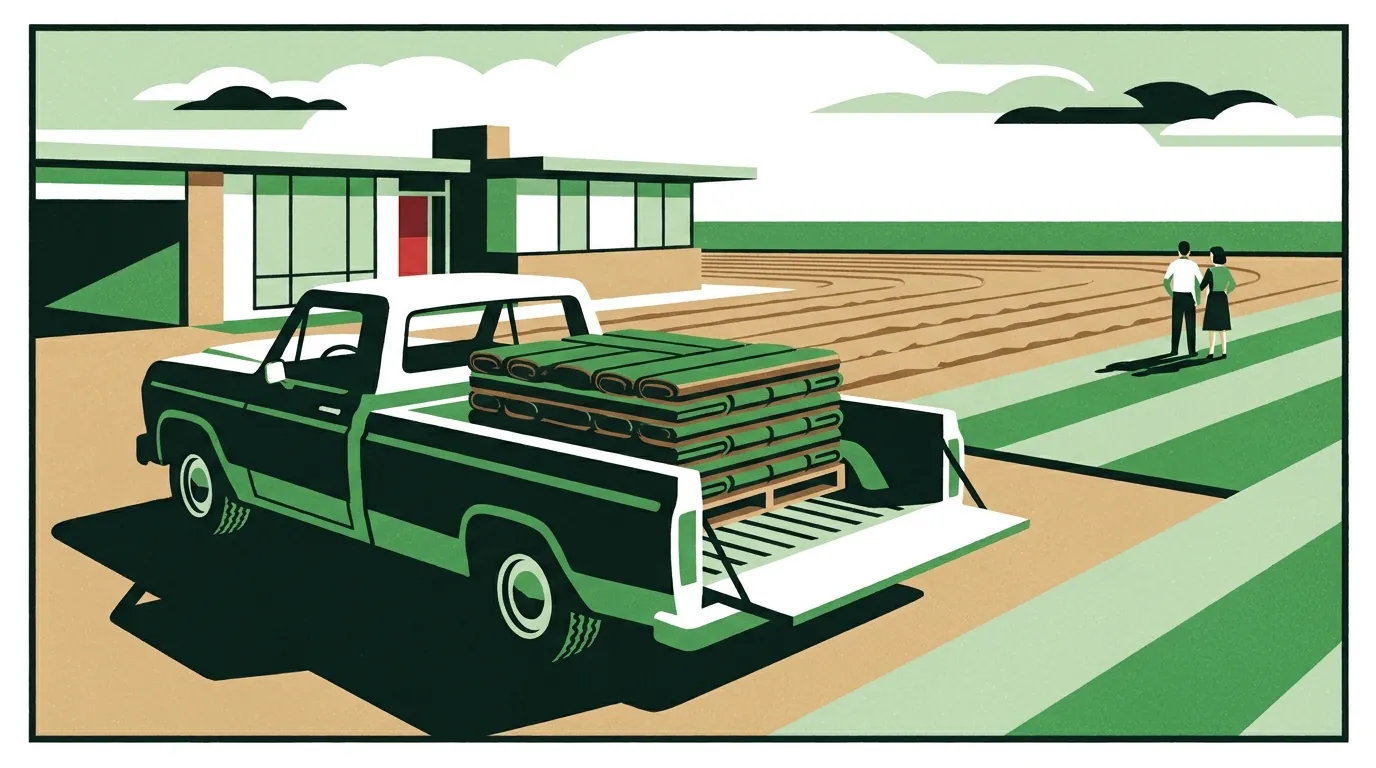
A pallet of sod is a heavy, concentrated load. Before you plan to pick one up:
- Read your payload. The tire and loading sticker on the driver’s door jamb gives the maximum weight of passengers plus cargo. Many half-ton pickups are rated for less than a full, wet pallet.
- Count everything. Payload includes you, your passengers, a toolbox and any hitch weight from a trailer.
- Check the trailer. A trailer’s rating, its tires and the tow vehicle’s rating all have to cover the load.
- Loading and unloading. The farm can forklift a pallet onto your truck, but at home you’ll unload it by hand, roll by roll. At 40 to 70 lb a roll, a 45-roll pallet is a serious afternoon’s lifting.
- Split the load. Taking loose rolls in two trips, or paying for delivery, is often safer and quicker.
Delivery and your driveway
Delivery trucks usually set pallets down with a truck-mounted forklift. Point out where you want them: on a hard, level surface close to the lawn, off any septic area, and away from a fresh concrete or paver driveway that you’d rather not load with several tons. Ask whether the forklift can drive onto the lawn; often it can’t.
Watering on the pallet
Don’t soak sod on the pallet to keep it fresh. Wet pallets get even heavier and the middle of the stack can heat up. Keep pallets shaded, lay the sod the same day, and water it once it’s on the soil. The watering guide explains how much.
Weights here are estimates from typical weight per square foot. Ask the farm for the weight of their pallets before you haul, and never exceed your vehicle's or trailer's rating.
Questions people ask
- How much does a pallet of sod weigh?
- Roughly 1,600 to 3,500 lb, depending on the pallet size (400 to 500 sq ft) and how wet and thick the sod is. Many farms quote figures in the 2,000 to 3,000 lb range. Ask yours for the weight of their pallets.
- How much does a roll of sod weigh?
- A 2 × 5 ft roll covers 10 sq ft, so at about 4 to 7 lb per square foot it weighs roughly 40 to 70 lb. A 16 × 24 inch slab weighs roughly 11 to 19 lb.
- Can I carry a pallet of sod in my pickup?
- Check the payload rating on the sticker inside the driver's door. Many half-ton pickups are rated for less than the weight of a full, wet pallet, and that payload also has to cover passengers and anything else in the bed. Delivery or a trailer rated for the load is often the safer choice.
- Why does sod weight vary so much?
- Most of the weight is soil and water. Sod cut thicker, grown on clay, harvested after rain or watered on the pallet weighs more; sod grown on sandy or organic soils, or that has dried a little, weighs less.
- How much does sod weigh per square foot?
- About 4 to 7 lb per square foot when fresh. Weigh one roll or slab on a bathroom scale and divide by its square feet for a figure for your own sod.